


Rummy is a traditional card game originating from India, where players must arrange 13 cards into valid Sequences and Sets to win. With flexible Joker mechanics, a clear scoring system, and a fast-paced flow, this card game demands strategic thinking and strong observation skills. If you’re interested, continue reading the detailed game review below from Jilicrown.
Overview of Rummy and How the Game Works
Rummy uses two standard decks along with four Jokers, making a total of 106 cards, and supports 2 to 5 players per round. Each participant receives 13 cards and must form at least one Pure Sequence before making a valid declaration. The Printed Joker rule adds flexibility while maintaining strategic balance.
In the online version, the gameplay includes timed turns, automatic actions if time expires, and a clear Declare mechanism. Players must carefully manage their hand, understand scoring rules, and decide when to Drop or Declare to maximize their performance on Jilicrown.

Official Rules of Rummy Card Game
Before joining a table, it’s important to understand how Rummy is structured, from card distribution to declaration and scoring. Below is a complete breakdown of the essential rules that determine how each round works and how a player can legally win.
Game Setup and Basic Structure
Rummy is played using two standard 52-card decks along with printed Jokers, totaling 106 cards. The game usually supports 2 to 5 players, and each participant is dealt 13 cards at the start of a round. One card is placed face-up to begin the discard pile, and another card determines the Printed Joker for that session.
Players take turns in clockwise order. During each turn, a player must draw one card from either the closed deck or the open discard pile, then discard one unwanted card. The objective is to arrange all 13 cards into valid combinations before making a declaration.

Sequences, Sets and Joker Rules
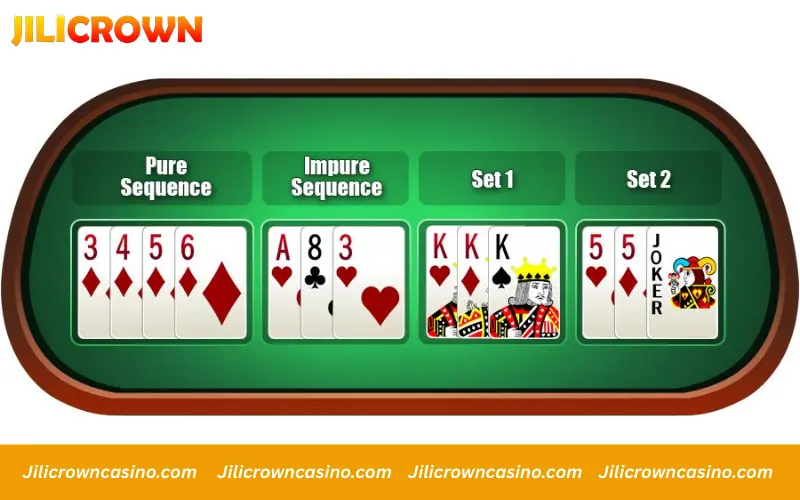
To win in Rummy, players must form valid Sequences and Sets. A Sequence consists of three or more consecutive cards of the same suit, while a Set contains three or four cards of the same rank in different suits.
At least one Pure Sequence — a sequence without using any Joker — is mandatory for a valid declaration. Jokers and Printed Jokers can substitute missing cards in Sets or Impure Sequences, but they cannot be used inside the first Pure Sequence. If a Joker card is selected as the Printed Joker, all Aces automatically become Printed Jokers for that round.
Declaration, Scoring and Drop Rules
A player can declare once all 13 cards are arranged into valid combinations, including at least one Pure Sequence and one additional Sequence. The first valid declaration wins the round.
Card valu
es are calculated as follows: A, K, Q, and J are worth 10 points; numbered cards carry their face value; Jokers and Printed Jokers are worth 0 points. The maximum penalty is typically capped at 80 points. A First Drop results in a 20-point loss, while a Middle Drop results in a 40-point loss. Final rewards are calculated based on the total losing points multiplied by the point value set for the table.
How to Win in Rummy – Pro Tips and Strategy Guide
Winning in Rummy is not just about luck; it’s about structuring your 13 cards correctly, managing jokers efficiently, and making smart decisions at the right time. Below are practical, game-specific strategies that can significantly improve your performance in competitive tables.
- Build a Pure Sequence First: Always prioritize forming a Pure Sequence before anything else. Without at least one Pure Sequence, your declaration will be invalid. Arrange natural consecutive cards early and avoid breaking potential pure runs for short-term gains.
- Use Jokers for High-Value Cards: Save Jokers and Printed Jokers to complete combinations that contain high-point cards like A, K, Q, and J. Since these cards carry 10 points each, reducing their risk through Joker substitution helps minimize penalties if another player declares.
- Track Discarded Cards Carefully: Observe what opponents discard. If multiple cards of the same rank are discarded, it becomes harder to complete a Set. Avoid chasing combinations that are statistically unlikely to complete.
- Decide Early Whether to Drop: If your initial 13 cards lack potential for a Pure Sequence, consider a First Drop to lose only 20 points instead of risking a full penalty later. This is especially important in high-value tables.
- Avoid Holding Unmatched High Cards: If you are unable to integrate high-point cards into Sequences or Sets, discard them early. Keeping loose face cards increases your loss if another player declares suddenly.
- Balance Speed and Accuracy Before Declare: Do not rush your declaration. Double-check that you have at least one Pure Sequence and one additional valid Sequence. An invalid declaration can result in maximum penalty points.
- Rearrange Cards Continuously: Use sorting features (if available) to reorganize your hand frequently. Visual clarity helps you spot hidden sequences or near-complete sets more efficiently.
- Watch the Points Cap (80 Rule): Remember that the maximum penalty is usually capped at 80 points. If your hand becomes too risky and scattered, a strategic Middle Drop may reduce long-term losses.
Why play Rummy on Jilicrown?
Choosing the right platform can significantly enhance your overall Rummy experience. Beyond understanding the rules and strategies, players also need a stable, fair, and smooth gaming environment to apply their skills effectively.

Fair Gameplay and Transparent Scoring
Jilicrown ensures that every round follows official Indian Rummy rules, including Pure Sequence validation, Joker mechanics, and capped penalty points. The scoring system is automated and transparent, reducing human error and ensuring fair results.
Smooth Interface and Auto Features
The platform offers helpful tools such as Auto Sort, timer indicators, and automatic declaration checks. These features reduce mistakes, especially for beginners, while still allowing experienced players to control their strategy.
Multiple Table Stakes
Players can choose from different bet values depending on their risk tolerance. Whether you prefer low-risk practice rounds or competitive high-stake tables, Jilicrown provides flexible options.
Secure and Stable Gameplay
The system handles disconnections and malfunctions automatically. If a round is interrupted after a bet is confirmed, the outcome remains valid according to platform rules, ensuring fairness.
Player reviews about Rummy on Jilicrown
Below are real-style player impressions after experiencing competitive Rummy tables, focusing on gameplay speed, fairness, and overall interface quality on Jilicrown.
| Name | Country | Review |
| Arjun Mehta | India | “The Pure Sequence validation is accurate and the timer keeps the game competitive. I like how the system auto-checks before declare.” |
| Miguel Santos | Philippines | “Gameplay is smooth and I haven’t faced lag issues. The drop option helped me manage losses when my hand was bad.” |
| Ahmad Rizal | Malaysia | “I appreciate the auto-sort feature. It makes arranging sequences easier, especially in fast rounds.” |
| Nguyen Hoang | Vietnam | “The scoring system is clear and capped at 80 points, so losses don’t spiral out of control.” |
| Suriya Chai | Thailand | “Tables feel competitive but fair. Jokers and printed jokers work exactly as per Indian Rummy rules.” |
FAQ about Rummy
Below are some of the most common questions players ask before starting a game of Rummy, helping clarify rules, strategy, and scoring mechanics in competitive online play.
Is Pure Sequence mandatory to win in Rummy?
Yes, at least one Pure Sequence is compulsory in Rummy. Without a pure run made of consecutive natural cards from the same suit, any declaration will be considered invalid, even if the rest of the hand is arranged correctly.
How many Jokers are used in a standard Rummy game?
A standard Indian Rummy game uses two full decks including printed Jokers. In addition to printed Jokers, one random card is selected as the Wild Joker for the round, and all cards of that rank become Jokers.
What happens if I make an invalid declaration?
If a player declares without forming the required Pure Sequence and valid combinations, the declaration becomes invalid. In most formats, this results in the maximum penalty, often capped at 80 points.
What is the difference between First Drop and Middle Drop?
First Drop occurs before playing your first turn and usually results in a smaller penalty, such as 20 points. Middle Drop happens after at least one turn has been played and generally carries a higher penalty, typically around 40 points.
How are points calculated in Rummy?
In Rummy, A, K, Q, and J usually carry 10 points each, numbered cards carry their face value, and Jokers carry 0 points. The total of unmatched cards determines the penalty score when another player wins.
Conclusion
In summary, Rummy is a strategic 13-card game that combines logical thinking, calculated risk management, and smart hand arrangement. From building a Pure Sequence to managing Jokers and deciding when to Drop, every decision directly impacts the final outcome.
If you want to experience competitive tables, smooth gameplay, and official rule-based scoring, explore Rummy on Jilicrown and apply the strategies discussed above to improve your performance.
MOMO Sakura – Author at JILICROWN, sharing casino tips, gaming guides, and insights into the world of online entertainment in the Philippines.