


Tongits Go is one of the most competitive three-player card games built around smart meld timing, fight decisions, and point control. Unlike a simple rummy-style card game, this version introduces multipliers, special melds, bonus cards, and a dynamic challenge system that can quickly shift payouts. In this comprehensive review, we break down rules, odds, reward logic, and practical Tongits strategy — and show why many players choose to experience it on Jilicrown.
What is Tongits Go?
Tongits Go is a digital adaptation of the classic three-player Tongits card game, designed around fast rounds, structured betting levels, and a more competitive settlement system. While the core objective remains reducing deadwood and forming valid melds, the online format introduces additional mechanics such as Fight challenges, special meld multipliers, and bonus card rewards.
Compared to traditional table play, this version runs on a fixed timer, includes defined entry levels (LV1–LV5), and applies a structured payout formula. The result is a more dynamic environment where strategy, timing, and risk control play a much bigger role than pure luck.
Basic Game Setup & Core Rules
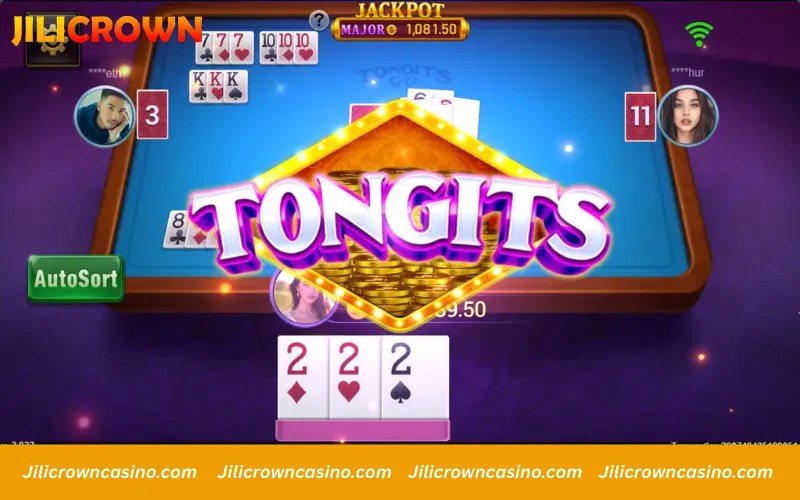
Tongits Go is played with a standard 52-card deck without Jokers and involves three players per round. Each player receives 12 cards, while the remaining cards are placed in the center as the community pile. The game proceeds counterclockwise, and every player has a strict 20-second timer to complete their turn.
Each turn follows a simple structure: draw one card, optionally form or update a meld, and then dump one card. Dumping is mandatory at the end of every turn. Players may draw from the community pile or pick up the most recently discarded card if it allows them to create a valid meld.
The objective is to minimize deadwood points by forming valid sets or sequences. A round can end when a player declares Tongits (no remaining deadwood), when a Fight is initiated and resolved, or when settlement occurs based on point comparison.
Player Turn Mechanics
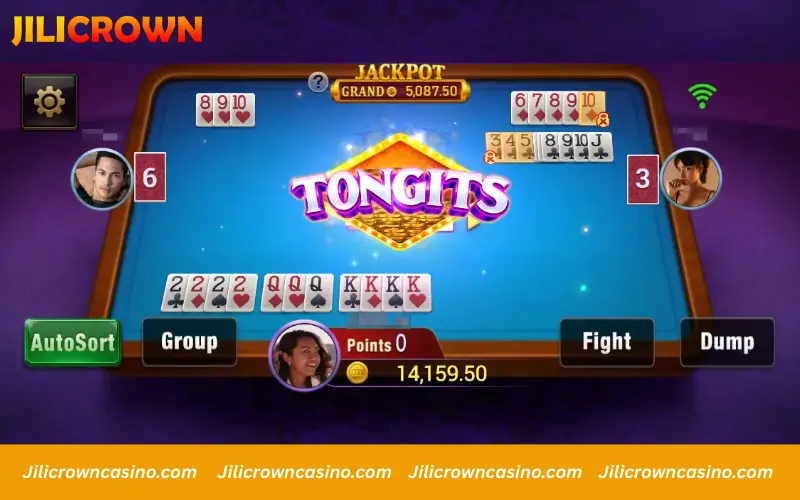
Each round in Tongits Go revolves around structured turn actions. Understanding how Chow, Meld, Sapaw, and Dump interact during your turn is critical for controlling tempo and minimizing risk.
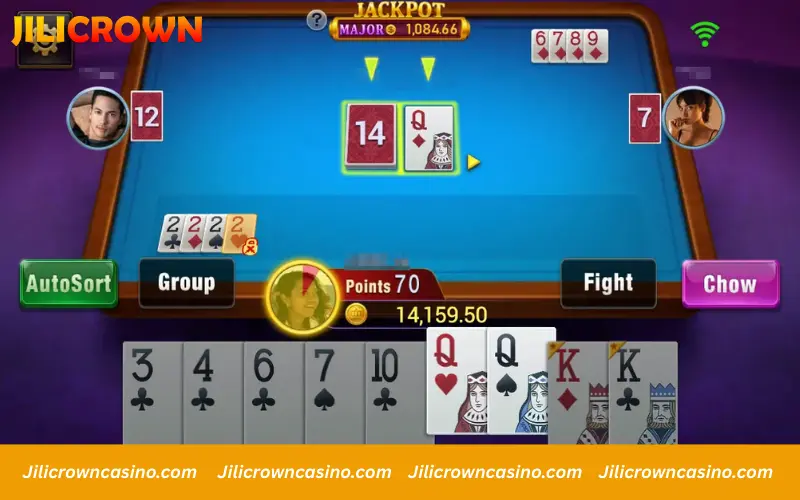
Chow (Picking from Dump Pile)
Chow occurs when the most recently dumped card can immediately form a valid meld with the cards in your hand. Instead of drawing from the community pile, you may choose to pick up that discarded card and directly lay down the created meld.
This move not only reduces your deadwood but also denies opponents from reclaiming control over that card.
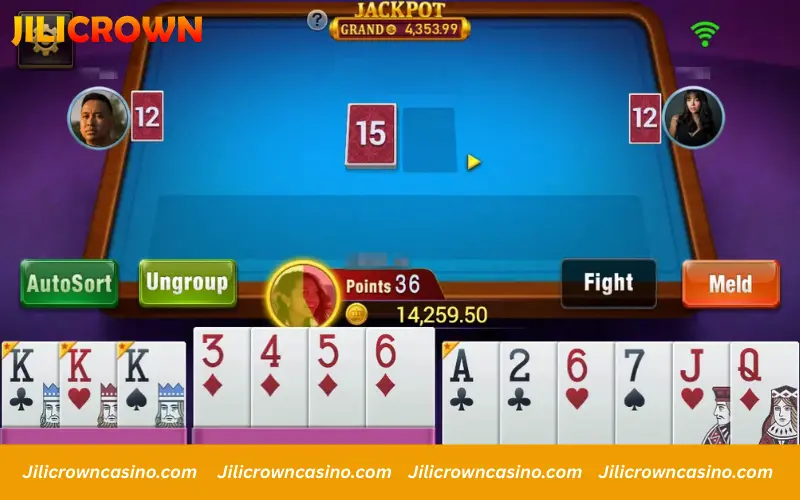
Meld
During your turn, you may lay down valid sets or straights as melds. Once placed on the table, those cards no longer count toward your remaining points.
Proper meld timing is important. Revealing combinations too early may expose your structure and open opportunities for Sapaw or Fight triggers.
Sapaw
Sapaw allows you to attach additional cards to an existing meld, either your own or another player’s. This reduces your remaining deadwood and can alter the strategic balance of the round.
However, once a meld has been used for Sapaw, certain Fight conditions may no longer apply.
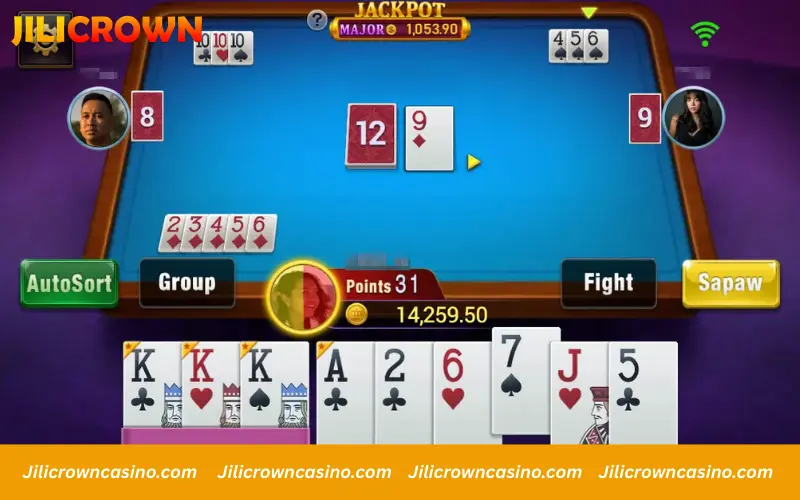
Dump
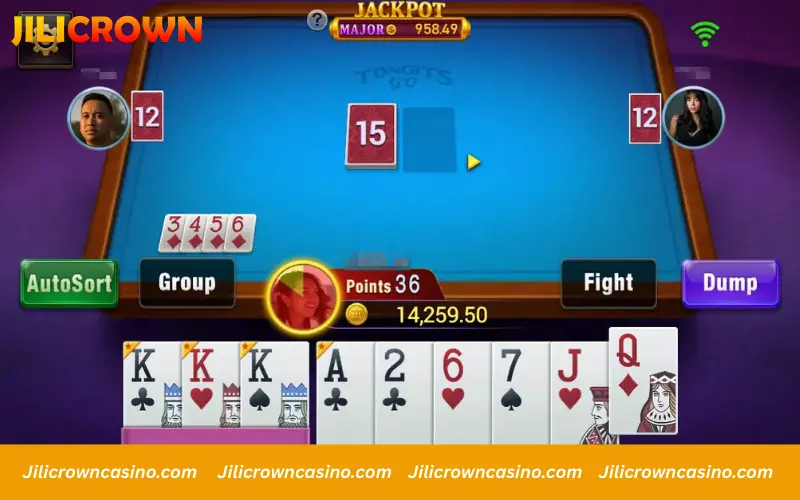
At the end of every turn, you must dump one card. This action officially ends your turn. The choice of which card to discard affects both your remaining point total and your opponents’ potential Chow opportunities.
If after dumping your deadwood reaches zero, you may immediately declare Tongits to win the round.
Winning Conditions & Settlement
A round in Tongits Go can end in several different ways depending on the state of the table and player actions. The most straightforward win occurs when a player successfully declares Tongits, meaning all remaining cards have been grouped into valid melds and no deadwood remains after the final dump.
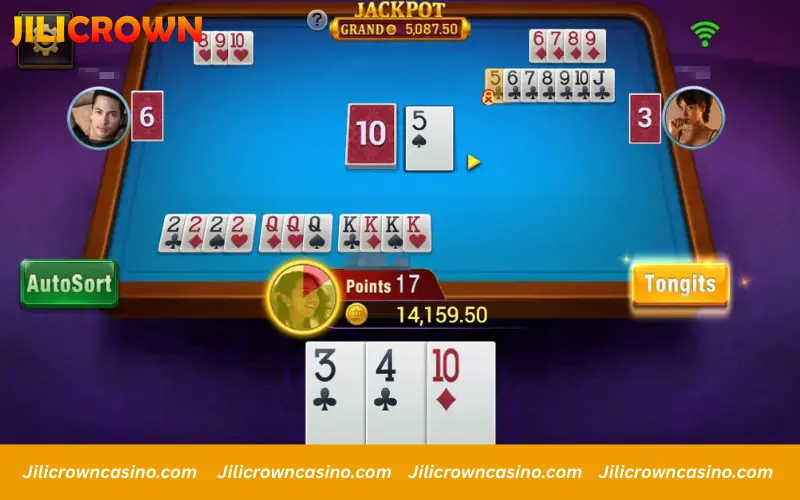
In Tongits Go, if no Tongits is declared, the round is settled by comparing remaining card points (deadwood). The player with the lowest total wins. Players without any valid meld and no Special Meld are considered Burned and automatically lose.
If a Fight is triggered, players must challenge or fold. The lowest card points win the comparison. In tie cases, the initiator loses; if the two non-initiators tie, the player seated before the initiator wins.
Fight & Challenge System Explained
Fight is the fast settlement mechanism in Tongits and directly impacts the final payout, so understanding when and how it is triggered is essential for every player.
During a draw turn, a player may initiate a Fight if they have already laid down at least one Meld on the table and that Meld has not been used by other players for Sapaw. Once Fight is activated, the round immediately shifts into point comparison based on the remaining Card Points in each player’s hand.
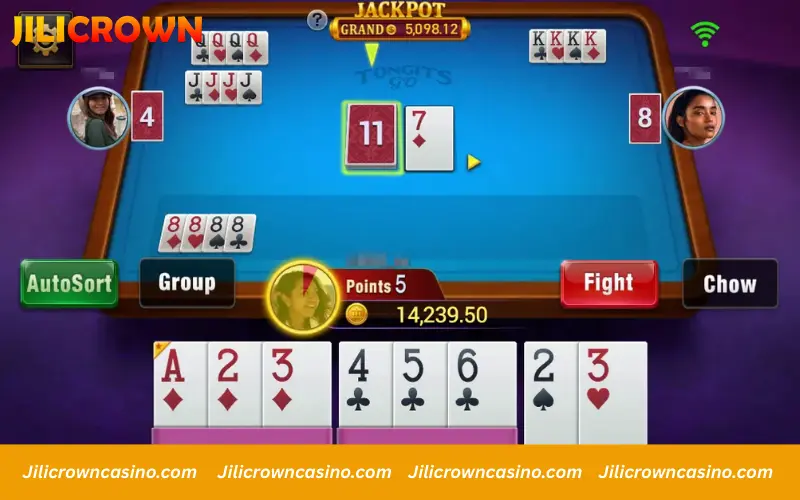
After a Fight begins, the challenged player has three possible responses. They may choose Challenge and directly compare Card Points — the player with fewer remaining points wins. They may also select Fold, which means declining the fight and settling according to the current stake and multipliers.
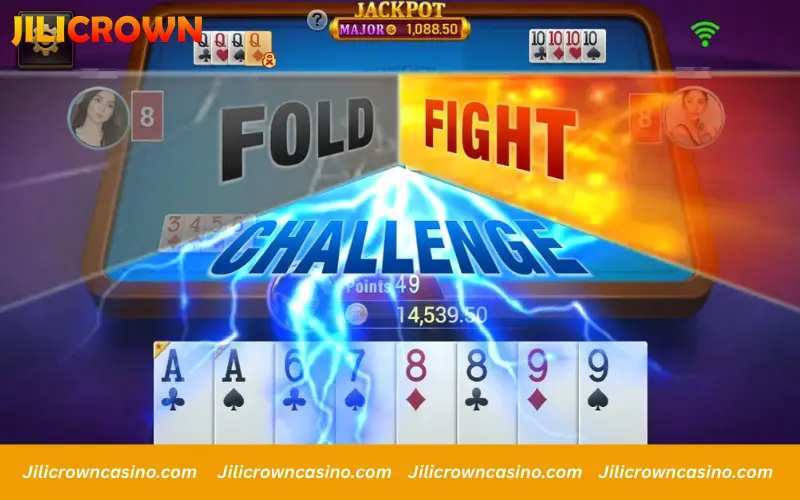
If a player has not laid down any valid Meld and holds no Special Meld, they will be Burned and cannot choose Challenge or Fold. In case of a tie, if the Initiator ties with another player, the Initiator automatically loses. If the other two players tie, the player seated before the Initiator is declared the winner.
Point System & Settlement Logic
Understanding the point system is crucial because Tongits is ultimately decided by deadwood — the total value of unmatched cards left in a player’s hand at settlement.
In Tongits Go, card values are calculated as follows:
- A = 1 point
- 2–9 = face value
- 10, J, Q, K = 10 points
- Cards that are already arranged into valid Melds do not count toward your total score.
At the end of a round — whether through Fight, Fold, or a normal finish — the player with the lowest deadwood wins. Managing your unmatched cards efficiently is therefore the core strategic element of the game.
Quick Reference Table
| Card | Point Value |
| A | 1 |
| 2–9 | Face value |
| 10, J, Q, K | 10 |
Card Combinations & Special Rules in Tongits Go
Understanding different card combinations is essential to control your strategy and maximize payouts. Below is a structured overview of all valid meld types and special scoring conditions in Tongits Go.
| Hand / Type | Explanation |
| Straight Flush | Three or more consecutive cards of the same suit. Cannot be formed using Q, K, A as part of the sequence. |
| Kind of Meld (Set) | Three or four cards with the same rank but different suits. |
| Special Meld (Secret Meld) | A pure sequence of five or more consecutive cards, or four identical-ranked cards of different suits. Each Special Meld increases the final payout multiplier. Players holding Special Melds cannot be considered Burned. |
| Bonus Cards | A and K are counted as Bonus Cards. If the winner holds N Bonus Cards at settlement, the loser pays an additional N times the ante. Melds already placed on the table do not count as Bonus Cards. |
| Sagasa | Occurs when a player starts with Three of a Kind and completes it into Four of a Kind using a community card. Each Sagasa forces the loser to pay an additional N times the ante. |
Reward Formula & Payout Breakdown
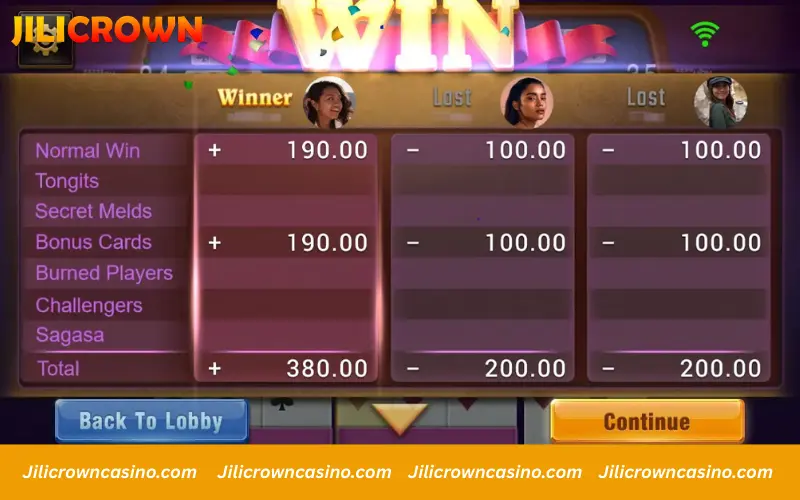
Tongits Go calculates the final payout based on multiple winning factors, not just the basic win. The total reward is derived from Normal Win, Tongits declaration, Secret Melds, Bonus Cards, Burned players, Challengers, and Sagasa, then multiplied by 0.95 according to the platform’s settlement rule.
Reward Formula: Loser’s (Normal Win + Tongits + Secret Melds + Bonus Cards + Burned Players + Challengers + Sagasa) × 0.95.
Winning Strategy for Tongits Go
To play more effectively, you need proper timing, observation skills, and bankroll discipline. Below are key strategies presented in a clear, practical format:
- Don’t open Meld too early: Avoid exposing your sets immediately unless necessary. Early Melds allow opponents to Sapaw and reduce your flexibility for Fight decisions.
- Observe discard patterns carefully: Track which suits and ranks are consistently dumped. This reveals what opponents are not building and helps you avoid feeding their potential combinations.
- Choose the right moment to Fight: Initiate Fight only when your deadwood is low and your Meld is secure. Poor timing can turn a strong position into a losing round.
- Discard high-value cards before settlement: A and K count as 10 points. If you cannot convert them into Melds, dump them before endgame to reduce deadwood risk.
- Prioritize building Special Melds when possible: A five-card sequence or four-of-a-kind increases payout potential and protects against being Burned.
- Select tables based on bankroll: Play within safe limits. Avoid entering high Boot levels unless your bankroll can comfortably handle variance.
FAQs about Tongits Go
Before diving deeper, these FAQs about Tongits Go address practical gameplay decisions, strategy timing, and common settlement scenarios players often face.
Is it better to declare Tongits or wait for settlement?
Declare Tongits only when your deadwood is truly 0 and opponents are unlikely to initiate a Fight. Waiting can be safer if you suspect someone is building a strong hand or Special Meld.
When should I initiate a Fight instead of continuing to draw?
Fight is optimal when you already opened a Meld, your deadwood is low, and opponents appear to hold high-value cards. Poor timing can backfire if someone has hidden Special Melds.
How do Special Melds affect payouts?
Special combinations (like five-card sequences or four-of-a-kind) multiply the ante and significantly increase volatility. They also protect you from being Burned in settlement.
Why is managing A and K important in the late game?
A and K count as 10 points each. Holding them without converting to Meld increases deadwood risk and can cause you to lose during Fight or settlement.
How do I reduce the risk of getting Burned?
Always aim to open at least one valid Meld before endgame. If you fail to lay down any combination and have no Special Meld, you may be automatically Burned.
Final Thoughts
Tongits Go is a strategy-focused card game where timing, observation, and calculated risk matter more than luck. The volatility increases through Special Melds, Sagasa, and Bonus Cards, making each round unpredictable yet skill-driven.
It is especially suitable for players who enjoy three-player competitive dynamics and tactical decision-making. If you want a smoother interface and stable gameplay experience, try Tongits Go today on Jilicrown and test your strategy at the tables.
MOMO Sakura – Author at JILICROWN, sharing casino tips, gaming guides, and insights into the world of online entertainment in the Philippines.